


The Importance of Martial Arts Training and Competition
Man has been a part of fighting and battles since the beginning of man. His movements are natural- atavistic reactions similar to those of...

Police Officer Survival Guide – Where Crooks Get Guns
A year long study was made by the Dallas Police Department and the Bureau of Alcohol, Tobacco and Firearms in which recovered guns that...

Sudden In Custody Death Syndrome (SICDS)
Introduction
What is Sudden In Custody Death Syndrome (SICDS), or Positional Asphyxia, and why is being knowledgeable about it important to my department and its...

Stripes and Bars: Self-discipline
NOT TOO LONG AGO, I was asked to identify the one leadership characteristic that rises above all others as the most important. Though I...
Stripes and Bars: Lead, Don’t Blame
WHEN SOMETHING GOES WRONG at an agency, administrators go into self-preservation mode. This, in turn, has a cascading effect all the way down to...

The Winning Edge: One Stance, Three Uses
If you sit around chatting with instructors who teach in law enforcement, you will find a great deal of diversity on any training topic...

Is Your Firearms Training Complete
Do you remember your police academy firearms training? During the summer of 1986, at the local county police academy, a basic recruit class enjoyed...

Be Physically and Mentally Prepared
Officer Stacy Lim from the Los Angeles Police Department pulled into her driveway after an enjoyable evening of softball practice. When Lim got out...

Best Practices: Goal-Oriented Training
Many in law enforcement view training as something to try to get out of. Since it’s often seen as a necessary evil, it’s always...
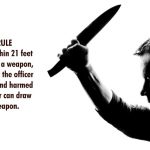
Edged Weapon Defense: Is or Was the 21-Foot Rule Valid? Part 2
PoliceOne.com Editors Note: For the record, the 21-Foot Rule, when accurately stated, says that in the time it takes the average officer to recognize...
21 Feet is Way Too Close!
It is common knowledge that a suspect, armed with an edged weapon and within 21 feet of a police officer presents a deadly threat. Why?...

Law Enforcement Training and Use of Force
Introduction
Police officers must use force when placing uncooperative subjects under arrest, as well as during situations of unrest (e.g. riots, protests where property is...

Got a Second? A Journey into the OODA Cycle
Introduction
Today’s environment of accelerating scientific discoveries and technological change bring ever-improving hardware to the end user. In this climate is it easy to overlook...
Best Practices: How To…Respond Instead of React
The Aug. 9, 2014 shooting of Michael Brown in Ferguson, Missouri, triggered a chain of events that changed how the public perceived law enforcement....
Police Officer Survival Guide – The Use of Police Color Codes
One of the modes used in training, which is helpful, is the use of police color codes. The color codes, developed a number of...
Best Practices: Stress Management
Stress is an officer’s number one nemesis. During a call, it creates automatic psychological and physiological responses that reduce your effectiveness. Too much stress...